Understanding these obstacles allows you to support your child at home and communicate more effectively with their teacher. Phonics isn’t only about recognizing letters; your child must connect sounds to symbols, understand patterns, and develop the confidence to read independently. And that’s a tall order for a 6-year-old still developing language skills.
Here are seven common phonics challenges and tips for helping young readers overcome them.
1. Sound-to-Letter Confusion
One of the first hurdles your child may encounter is simply connecting the correct sounds with the letters they see. While adults take this for granted, it’s a complex cognitive task. For instance, the letter “c” can sound like /k/ (as in “cat”) or /s/ (as in “city”). Those inconsistencies can be confusing and discouraging when you’re just learning.
You may hear your child mispronounce simple words or guess randomly based on the first letter. This is usually a sign that they’re trying to apply what they’ve learned, but they find the rules unpredictable. Phonics instruction helps clarify these inconsistencies over time, but until then, it’s natural for kids to struggle.
2. Blending Sounds
Another major challenge is blending. Your child might be able to identify the sounds in “c-a-t” but struggle to combine them smoothly into “cat.” This step is essential in phonics because reading involves merging sounds quickly and accurately. If your child stalls between each letter or can’t seem to blend sounds into a whole word, it may feel like they’re stuck.
That doesn’t necessarily mean they’re behind. It just means they need more practice and support. Blending is a skill that requires repetition, modeling, and patience. As a parent, you can help teach your first grader phonics by sounding out words together and encouraging them to stretch and blend sounds smoothly.
3. Poor Phonemic Awareness
Phonemic awareness refers to the ability to identify and manipulate the phonemes (sounds) that make up words. With strong phonemic awareness, a student can see /b/ /a/ /t/ and sequence those sounds into the word “bat.” Conversely, a student can see the word “bat” and break it down into its component sounds.
Phonemic awareness is the foundation for reading, and without it, students will struggle to read. The good news is that phonemic awareness can be developed through activities that help students isolate sounds (“What’s the first sound in bat?”) and manipulate sounds (“Take out the /a/ sound and replace it with an /i/ sound.”) Rhyming games are helpful as well.
4. Auditory Processing Differences
Some first graders struggle with phonics due to underlying auditory processing challenges. If your child has trouble distinguishing between similar sounds (like /b/ and /d/ or /ch/ and /sh/), they’ll likely have a harder time decoding accurately.
In these cases, standard phonics instruction might not be enough. Talk to your child’s teacher about techniques like sound sequencing games, using manipulatives like blocks, or rhyming games. If the issue continues, ask your child’s teacher about additional support or educational evaluations. Early intervention is key.
5. An Over-focus on Speed
When kids begin to decode successfully, they may have a tendency to read fast so they can get through the material and move on to the next activity. But fluent reading isn’t just about going fast. It’s about reading with understanding. If your child races through sentences but has no idea what they just read, phonics alone won’t solve the issue.
That’s where a focus on comprehension comes in. Encourage your student to stop and think about what they’ve read. Ask them questions about the story sequence, main idea, characters, and inferences. Reinforcing meaning helps keep reading from becoming a robotic task and helps your child understand the purpose behind their reading.
6. Limited Vocabulary
Phonics helps children decode words, but if they don’t understand word definitions, it’s harder for them to connect those words to something meaningful.
A child might be able to sound out “twig,” but if they’ve never heard the word before, they won’t recognize it as correct and may lose confidence. Or they may come across words with more than one meaning and not understand them in a different context, like knowing “bark” as the sound a dog makes but not as part of a tree.
Background knowledge and vocabulary development are key components of phonics success. Reading aloud to your child, discussing new words, and exploring different topics all help to build a stronger foundation. When a child knows what a word means, it becomes easier to read and remember.
7. Inconsistent Practice
Reading is like any other skill. The more your child practices, the better they get. But first graders often get inconsistent phonics practice, especially outside the classroom. Progress slows if reading becomes a “once in a while” activity instead of a daily habit.
You might think a 10-minute reading session is insignificant, but every little bit counts for a child learning to read. Consistent exposure to books, sounds, and word patterns helps phonics skills stick, so do your best to build reading practice into your daily schedule.
Every Struggle Is a Step Toward Mastery
When you understand what your child is going through, you can step in with support, empathy, and the right tools. Remember, reading is not just decoding a set of sounds. It’s about connection, confidence, and curiosity. By staying involved, offering gentle guidance, and nurturing a love of words, you can help your child turn those struggles into stepping stones to their second grade reading and beyond.
Video

Infographic
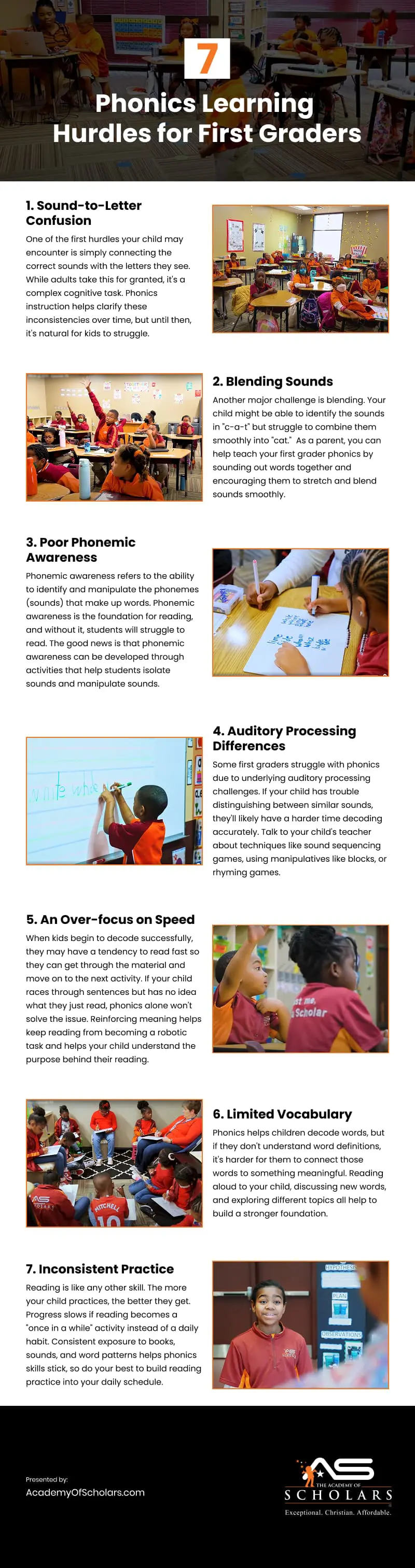
First grade is often the year when reading begins to take hold. Yet, phonics can still pose significant challenges that influence a child’s confidence and progress. This infographic highlights seven common hurdles first graders face in phonics learning.