Learning a second language is a priceless skill for your child. This is especially true for Spanish, as approximately 45 million Americans speak Spanish as their primary home language. Spanish fluency becomes a lifelong skill that can improve future academic and employment opportunities.
If you want your child to learn Spanish, research supports teaching them early. Early exposure has been associated with:
- Boosting the part of the brain associated with language processing
- Increasing brain activity related to problem-solving
- Improving pronunciation
- Enhancing memory, critical thinking, and the ability to switch between tasks
- Improving language retention
There’s little doubt that exposing your child to Spanish instruction at an early age is useful, but the challenge is figuring out how to engage your child in the process. Read on to learn some practical ideas.
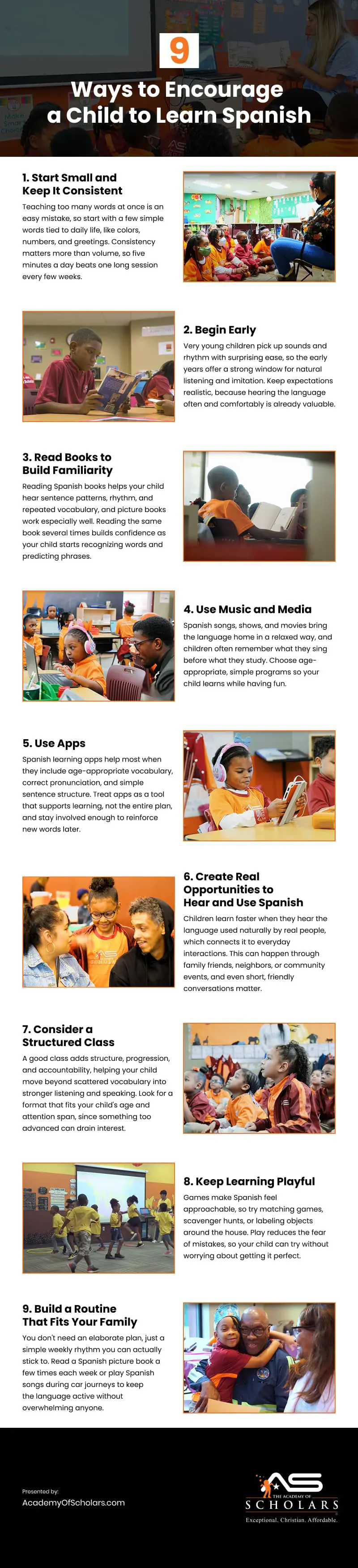
1. Start Small and Keep It Consistent
One of the easiest mistakes to make is teaching too many words at once. Yes, young children with their highly “plastic” brains can absorb a great deal, but they still need repetition to make these words stick. If you move too fast and introduce too much too soon, your child may confuse words or lose confidence.
You can start with a few simple words tied to daily life. Colors, numbers, greetings, family words, and food names often work well. Use them often enough that your child begins to recognize them without strain. A few familiar words spoken regularly can do more than a long vocabulary list used once.
Try things like writing a grocery list in Spanish instead of English, or starting the day by greeting your child with “buenos días” rather than “good morning.”
Consistency matters more than volume at this stage. Five minutes a day, every day, will likely give you better results than one long session every few weeks. Learning a second language should be part of your family’s routine to make it feel more lived and less like study.
2. Begin Early
Very young children often pick up sounds and rhythm with surprising ease. Their ears are still adjusting to language patterns, which can make early exposure especially useful. That does not mean an older child cannot learn Spanish, but the early years offer a strong window for natural listening and imitation.
If your child is preschool age or in the early elementary years, you can introduce Spanish through play, songs, simple books, and short conversations. Also, consider a private pre-K school that offers Spanish lessons as part of its curriculum, so your child learns both at school and at home.
Keep your expectations realistic. Your child does not need to speak full sentences right away. Hearing the language often and comfortably is already valuable.
A child who hears Spanish early may grow more comfortable trying new words later. That comfort can make future lessons feel less intimidating.
3. Read Books to Build Familiarity
Reading Spanish books with your child can help them hear sentence patterns, rhythm, and repeated vocabulary. Picture books work especially well at this stage because the images support understanding. Your child can follow along even if they do not know every word.
Just like when you do educational reading in English, you do not need to choose long or difficult Spanish books. A short story with repeated phrases can be enough. If you read the same book several times, your child may start recognizing words and predicting phrases. That repetition builds their confidence and helps secure their knowledge.
4. Use Music and Media
Spanish songs, TV shows, and movies can bring Spanish into your home in a relaxed way. Children often remember what they sing before they remember what they formally study. A catchy song can introduce new vocabulary without turning the moment into a lesson.
Television and movies can help too, especially if they are age-appropriate and simple enough for your child to follow. You might choose a familiar show dubbed in Spanish or a short educational program designed for young learners. This exposure will continue to help their learning, but they’ll be too busy having fun to notice.
5. Use Apps
Spanish learning apps can be helpful, especially when they include appropriate vocabulary, correct pronunciation, and simple sentence structure.
Many children enjoy apps with an interactive format. The key is to treat apps as tools to support learning, not as the entire learning plan.
Look for apps that match your child’s age and attention span. You also want to stay involved enough to know what your child is learning. If an app introduces new words, you can repeat them later in the day so the language does not stay trapped on a screen.
Apps work best as a scaffold when they reinforce what your child is already hearing through books, songs, conversation, or class instruction.
6. Create Real Opportunities to Hear and Use Spanish
Children often learn language faster when they hear it used naturally by real people.
Spending time with native Spanish speakers can help your child connect the language to everyday interactions rather than just through their lessons. In these conversations, they hear pronunciation, pace, and expression more authentically.
That does not necessarily require a formal arrangement. It might happen through family friends, neighbors, church members, or community events. Even short, friendly conversations can matter. Your child may start with greetings or a few simple responses, and that is enough.
Real-world exposure also helps children understand that Spanish is not just a school subject. It is a living language people use to connect, work, laugh, and share everyday life.
7. Consider a Structured Class
If your chosen school doesn’t offer Spanish lessons from an early age, there are other ways you can bring in formal language lessons for your child.
A good online Spanish class can add structure, progression, and accountability to their learning. If your child enjoys learning Spanish and wants more guidance, a class can help them move beyond scattered vocabulary into stronger listening and speaking habits.
An extracurricular class also helps when you want your child to hear correct pronunciation and receive regular instruction from someone who knows how to teach young learners. If you choose this route, look for a format that fits your child’s age, attention span, and comfort level. A class that is too advanced or too long can quickly drain interest.
Structured learning works especially well when it is balanced with lighter exposure at home. Your child might attend class once or twice a week, then hear Spanish songs, books, and simple conversation the rest of the time.
8. Keep Learning Playful
Games can make Spanish feel approachable. Matching games, memory cards, scavenger hunts, and simple role-play activities can all reinforce vocabulary in a low-pressure way. Children tend to stay engaged longer when they are moving, laughing, and having fun.
You might label a few objects around the house in Spanish, play a color-finding game, or ask your child to name foods during snack time. A child who says “rojo” while finding a red toy is still learning, even if the moment feels casual.
Play also reduces fear of mistakes, because playtime doesn’t carry the same stresses as official study time. Your child may feel that they can try and not worry if they don’t get it 100% right the first time.
9. Build a Routine That Fits Your Family
You do not need an elaborate language plan to make progress. A simple weekly rhythm can be enough, and you’re more likely to stick to a routine that feels manageable.
Try to read one Spanish picture book together a few times each week, or play Spanish songs during car journeys.
These small practice sessions will soon become routine and keep Spanish active without overwhelming your child or your schedule.
Keep the Focus on Connection
Children usually stay interested when they feel successful and supported.
Praise effort. Repeat words kindly. Let them hear the language often enough that it feels familiar. If they resist one method, switch to another. A child who does not enjoy flashcards may love songs. A child who tunes out a video may respond well to a game.
Language learning is a long process, and the best progress is slow and steady. The early goal is to keep your child interested and build their confidence. If you help your child enjoy Spanish now, you give them a stronger reason to keep learning later.
Video
Infographic
Exposing your child to Spanish instruction early on is beneficial, and engaging them in the learning process can be both fun and effective with the right approach. Take a look at nine ways to encourage a child to learn Spanish in this infographic.